


As AI translation becomes increasingly adopted in large-scale technical document localization, enterprises are gaining efficiency — while simultaneously exposing new quality and compliance risks.
In our projects supporting high-end manufacturing and medical device companies going global, Landelion has observed that AI can significantly reduce repetitive workload. However, it presents structural blind spots in terminology consistency, safety-critical content, regulatory semantics, and version synchronization.
The real question is not whether to use AI — but how to define its participation ceiling, and where to introduce human review and expert validation, ensuring cost efficiency never compromises business safety.
1. Key Risk Insights: Three Structural Limitations of AI in Technical Documentation
Accuracy is the lifeline of technical documentation. Once terminology deviates or safety instructions are weakened, the product itself becomes unreliable.
1.1 Loss of Terminology Control
Technical documents require strict terminology consistency across documents, product lines, and even version updates. In practice, AI often fails in three areas:
Context ambiguity: A single term (e.g., “bond”) carries different meanings across industries. Generic models often select incorrect translations.
Dynamic mismatch: Rapid product iteration vs. outdated terminology databases results in conflicting translations.
Cross-document inconsistency: Different manuals for the same product use varying terminology, creating operational confusion.
High-risk areas extend beyond terminology. Loss of formula superscripts/subscripts, altered code snippets or API examples, incorrect unit conversions (metric vs. imperial), and misinterpreted safety warning levels can escalate language issues into liability issues.
1.2 Contextual and Structural Gaps
Technical documentation depends heavily on long-range context, structured logic, and accurate image-text alignment. AI rarely fails at individual sentences — but often at systemic coherence:
Logical fragmentation: Cause-effect relationships across sections weaken, disrupting execution sequences.
Image-text mismatch: Interface labels and descriptions fail to align precisely.
Localization blind spots: Date formats, measurement standards, symbol usage, and cultural sensitivities require human oversight.
In safety-critical documents such as medical device manuals or industrial machinery guides, even minor deviations can escalate into compliance and liability risks.
1.3 Regulatory and Compliance Risks
Lack of regulatory awareness: AI does not understand the technical logic behind ISO, IEC, or other standards.
Legal semantic misinterpretation: Minor wording variations may drastically alter contractual liability.
Version synchronization failure: Automated multilingual updates lack reliability.
AI can carry efficiency — but it cannot carry responsibility.
Landelion Insight
The true risk is not using AI — but treating AI as a substitute for professional human judgment. In safety-critical documentation, lack of qualified oversight turns language errors into compliance failures and brand damage.
2. Quality Control Boundaries: Why Human Review Is Irreplaceable
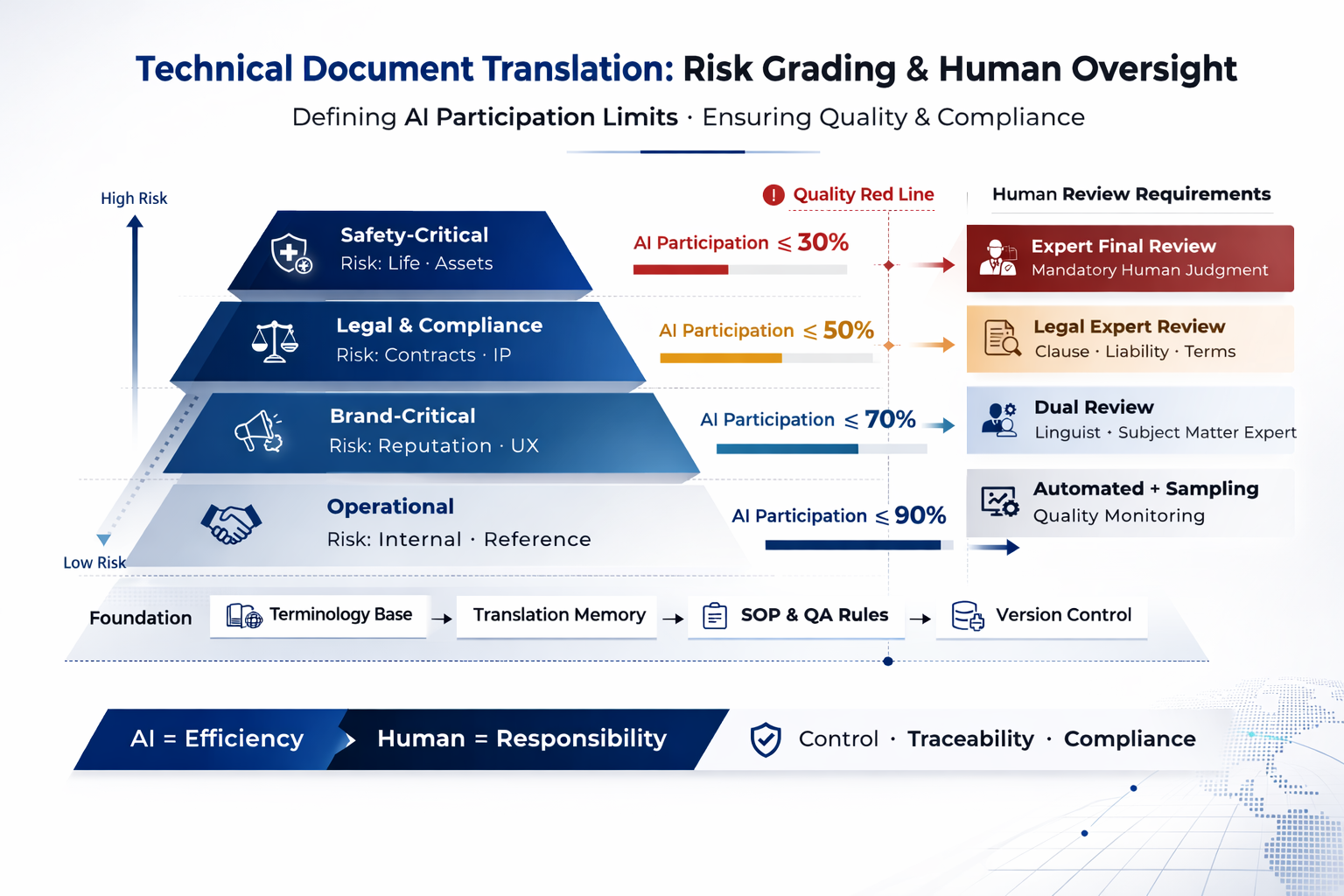
Landelion proposes a risk-based AI participation strategy: define risk first, then define AI involvement limits, and clearly establish mandatory human review boundaries.
| Risk Level | Document Type | AI Participation |
| Safety-Critical | Medical, Aerospace, Industrial Manuals | ≤ 30% (Expert Final Review Mandatory) |
| Legal & Compliance | Contracts, Patents, Regulatory Docs | ≤ 50% (Legal Specialist Review) |
| Brand-Critical | UI, Marketing, Product Docs | ≤ 70% (Dual Review) |
| Operational | Internal / API / Training | ≤ 90% (AI + Spot Check) |
3. Landelion’s Four-Stage Implementation Framework
A structured and auditable SOP ensures AI enhances efficiency while human expertise safeguards responsibility.
Stage 1: AI Draft & Intelligent Pre-processing
Stage 2: Professional Linguistic Review (Three-Layer Validation)
Stage 3: Domain Expert Verification
Stage 4: Quality Metrics & Knowledge Asset Accumulation
4. Conclusion & Action Steps
Technical document localization is not merely translation — it is controlled knowledge transfer and brand liability management. In the AI era, defining quality red lines and building traceable human-machine collaboration systems is fundamental to global competitiveness.
Contact Us | Explore Our Technical Documentation Localization Services
💬 Add Our Enterprise WeChat for a Customized Strategy
📚 Related Reading
Three Critical Scenarios Where Human Review Remains Essential in the AI Translation Era
Can AI Translation Support Biopharma Globalization? Why Human Review Remains Critical
How We Solved the Final 30% Challenge in Commercial AI Translation