


As global procurement decisions increasingly rely on digital validation, a company's international image is no longer defined by trade show brochures or product samples. Instead, it is shaped by how the brand presents itself across platforms such as LinkedIn, YouTube, and Facebook.
Before making initial contact, overseas buyers typically evaluate suppliers through social media content, assessing their level of expertise, industry understanding, and long-term partnership potential. Recent research shows that 77% of B2B buyers conduct independent online research before reaching out to sales, and around 40% of B2B marketers consider LinkedIn the most effective channel for generating high-quality leads.
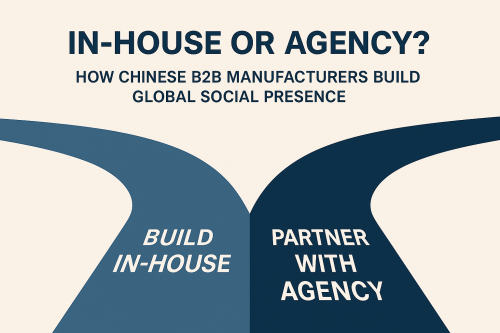
Against this backdrop, social media is no longer optional—it has become a strategic infrastructure for global B2B growth. Yet many Chinese companies face a critical decision: Should social media be managed in-house, or outsourced to a professional agency? This choice impacts not only budget allocation, but also brand positioning, content quality, and long-term growth sustainability.
I. Three Structural Challenges: Why "Being Capable" Doesn't Mean "Being Chosen"
Despite strong technical capabilities and manufacturing expertise, many Chinese B2B companies encounter fundamental barriers when communicating with global audiences.
1. Technical Content Does Not Equal Brand Trust
Many companies produce technically accurate content, yet fail to translate it into customer value. Common issues include content centered on product specifications rather than business scenarios, a manual-like tone lacking narrative differentiation, and failure to answer the key question: Why you?
As a result, even correct information fails to resonate. Overseas audiences often categorize such companies as "just another supplier," making it difficult to build emotional connection or premium positioning.
2. Fragmented Resources Limit Consistent Output
Marketing teams are often responsible for exhibitions, sales support, and website updates, leaving social media as a low-priority task. This leads to irregular posting frequency, lack of dedicated content planning, multilingual writing, and visual design capabilities, as well as inconsistency caused by team turnover.
Such discontinuity signals instability and undermines buyer confidence in long-term collaboration.
3. Global Markets Require Localized Strategies
Different regions have fundamentally different expectations. North America emphasizes ROI, integration, and case validation; Europe prioritizes compliance, sustainability, and technical ethics; while the Middle East and Southeast Asia focus on local support, delivery reliability, and cultural alignment.
A "one-content-for-all" approach often results in misalignment. Content may be published, but it does not truly resonate within the target market's decision-making framework.
II. In-House Team vs Agency: A Strategic Comparison
To address these challenges, companies must evaluate the differences between in-house operations and agency partnerships across key dimensions.
| Dimension | In-House Team | Professional Agency |
|---|---|---|
| Content Positioning | Strong in technical accuracy, but often limited to feature-driven descriptions | Translates technical capabilities into customer-centric value narratives with clear differentiation |
| Cross-Cultural Adaptation | Relies on individual experience, lacking structured methodology | Driven by regional insights and industry benchmarks, ensuring market-specific relevance |
| Operational Consistency | Affected by internal priorities, resulting in irregular posting cadence | Executes based on annual content calendars, ensuring consistent brand presence |
| Team Structure | Requires multiple roles (copywriting, design, video, media buying), leading to higher hidden costs | One-stop service model covering the full content and growth lifecycle under a single contract |
| Platform Strategy | Often adopts a "one-content-for-all" approach across platforms | Platform-specific strategies: LinkedIn for thought leadership, YouTube for scenario-based demonstrations |
| Growth & Conversion | Typically ends at content publishing, with limited follow-through | Integrates content, paid media, and performance analysis to drive measurable lead generation |
In practice, the most effective companies adopt a hybrid model, where internal teams provide technical expertise and industry knowledge, while agencies handle content transformation, localization, and growth execution. This approach balances depth and scalability.
III. Building a Scalable Global Social Media System
Based on experience working with companies in advanced manufacturing, industrial automation, AI/SaaS, and new energy sectors, effective global social media operations can be structured into three interconnected layers.
Layer 1: Brand Narrative System — Defining Who You Are
Companies must distill a clear value proposition, such as "helping European Tier 1 automotive suppliers reduce production downtime by 30%." This narrative should remain globally consistent while allowing for regional adaptation, and clearly differentiate the brand from established players such as Siemens or ABB.
The goal is simple: enable customers to understand your unique value within seconds.
Layer 2: Content and Operations System — Being Seen and Understood
Content must be both technically credible and culturally resonant. This requires multilingual transcreation (English, German, Japanese, Spanish), platform-specific strategies—LinkedIn for industry insights, YouTube for real production demonstrations, Facebook for team storytelling—and a strong emphasis on video content.
Transforming technical use cases into short, scenario-based videos significantly improves comprehension and engagement. Effective content balances rational clarity with emotional connection.
Layer 3: Growth and Conversion System — Driving Measurable Business Outcomes
A complete conversion framework must connect awareness to lead generation. This includes building a structured journey from reach to recognition, trust, and inquiry, tailoring content to different roles—engineers, procurement teams, and executives—conducting monthly data reviews, and integrating social media with websites and CRM systems.
Ultimately, social media should evolve from a visibility channel into a measurable lead-generation engine.
Conclusion: Social Media as a Trust Infrastructure
For Chinese B2B companies, global social media is not just a marketing tool—it is the foundation for rebuilding trust in international markets. It requires more than translation; it demands alignment in understanding. It is not just about publishing content, but about creating value resonance.
Choosing an in-house team means investing in long-term organizational capabilities. Working with an agency requires selecting a partner with deep industrial expertise and localization capabilities. Regardless of the approach, success depends on clear strategy, structured content planning, and data-driven optimization.
Take Action
Landelion specializes in global communication for high-end B2B industries and has helped numerous Chinese companies establish strong brand presence across Europe, the Middle East, and Southeast Asia. We provide end-to-end solutions, from brand narrative development and multilingual content production to social media growth execution.
👉 If you want to transform social media from a cost center into a growth engine, contact us for a tailored global strategy.
📩 Contact us | Explore enterprise language service solutions
💬 Add us on WeChat to book your consultation.