


The problem with B2B overseas social media content, more often than not, is not about posting too little – it is about content that does not align with the customer’s current decision‑making stage.
The same customer asks different questions at different points – when they first encounter your company, when they start comparing solutions, and when they enter the pre‑contact validation phase. During the awareness stage, customers need to understand what problem your company solves. During the comparison stage, they need to assess whether your solution fits their business scenario. During the pre‑contact validation stage, they need to see concrete case studies, evidence, and trust signals.
If companies only update content according to their own publishing calendar, without distinguishing which stage the customer is in, the content becomes a one‑way broadcast: the company keeps posting, but customers cannot find the information they need at that moment.
Therefore, B2B overseas social media content cannot be planned simply around “what to post today”. It must go back to the customer decision path and determine what content, what evidence, and what next steps are needed at each stage.
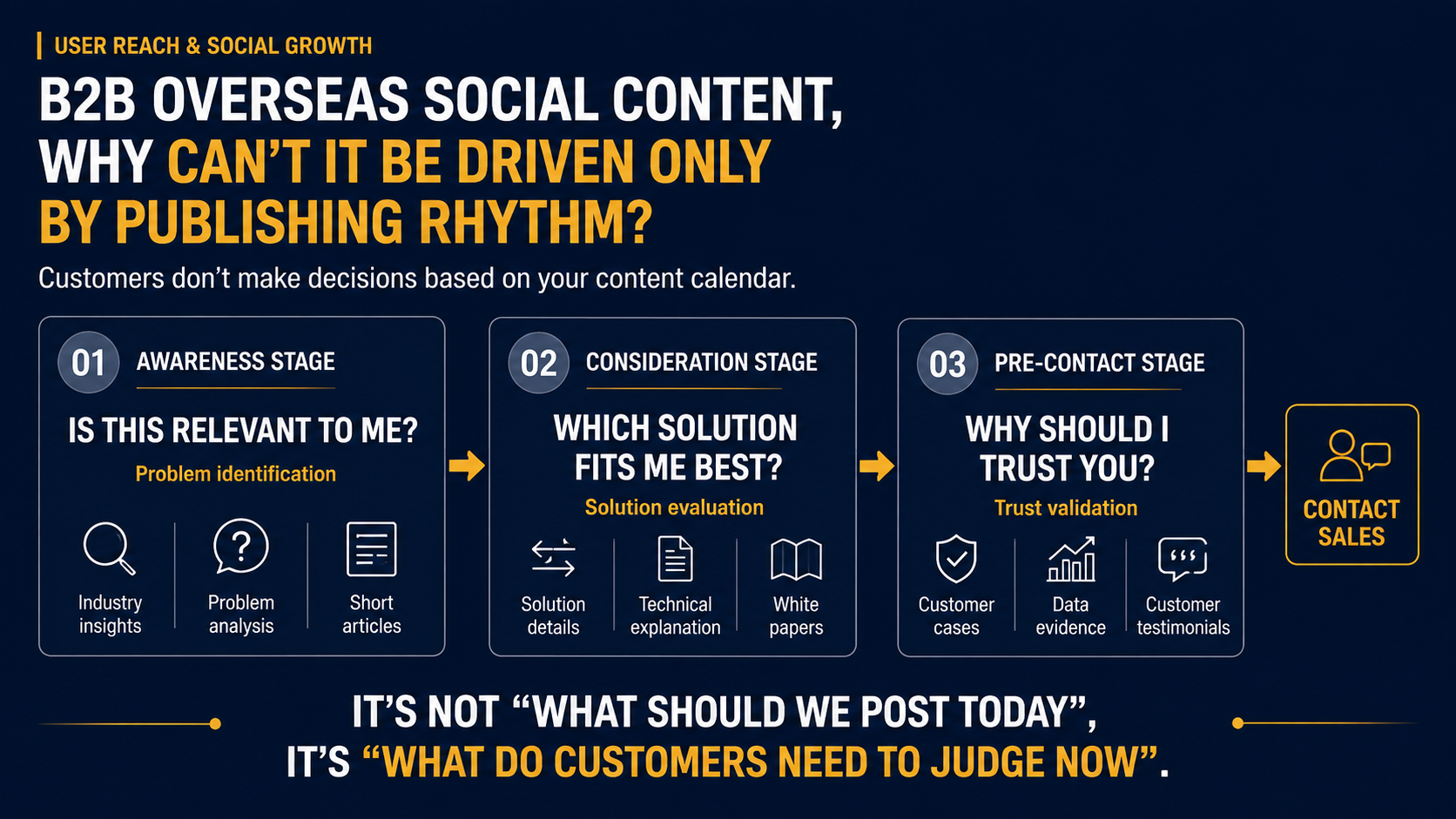
I. What do customers need at each of the three decision stages?
B2B purchasing decisions are rarely linear. Customers may revisit problem, solution, and case information multiple times, but in terms of content consumption, they still go through several relatively clear stages: first confirming the problem, then evaluating solutions, and finally validating whether the supplier is trustworthy.
Stage 1: Awareness – customers are deciding “is this worth my time?”
At this stage, customers have just become aware of a problem, or are trying to define it. Their core questions are: What is this? What does it have to do with me? Is it worth learning more?
If content cannot help customers quickly determine whether “this is relevant to my problem”, they are unlikely to dig deeper.
What customers need at this stage: problem‑oriented rather than product‑oriented – first help customers recognise that “this is my problem”; low‑threshold and digestible – text posts, short articles, concise industry insights; not sales‑pushy – customers haven’t confirmed the problem yet, so they don’t need a solution.
LinkedIn research also shows that in the early awareness stage, buyers discover new brands through professional perspectives, industry content, and individual creator content. This means that awareness‑stage content cannot be limited to company news or product launches – it must first help customers identify their problem, build interest, and form a reason to continue learning.
Stage 2: Comparison – customers are evaluating “how is your solution different from others”
Customers have confirmed the problem exists and are actively looking for possible solutions. Their core questions are: What solutions are available? How is your solution different from others? Which one best fits my situation?
At this stage, customers actively search, compare, and research. They need information that helps them make decisions, not one‑way product promotion.
What customers need at this stage: solution‑oriented – show “how to solve the problem” rather than “what we have”; comparative information – help customers understand differentiation; deep content – white papers, technical documentation, detailed solution guides, case breakdowns.
Buyer behaviour data also shows that B2B buyers are increasingly completing self‑directed research before engaging with sales.
This means that during the awareness and comparison stages, content needs to have stronger standalone carrying capacity. Customers may not immediately contact sales, but they will use content to determine whether a solution is worth further investigation.
Stage 3: Pre‑contact validation – customers are confirming “why should I trust you”
Customers have largely narrowed down their options and are doing final validation. Their core questions are: Is this information credible? Are there similar customers or project experience? Is the risk of moving forward manageable?
At this stage, what customers need most is verifiable information. They no longer need to hear “what you can do” – they need to see “what you have actually done”.
What customers need at this stage: evidence‑driven – case studies, customer testimonials, verifiable data; specific rather than vague – publicly disclosable customer names or types, traceable project backgrounds, verifiable project outcomes; signals that lower decision risk – industry recognition, certifications, repeat purchases from long‑term customers.
G2’s 2025 Buyer Behavior Report notes that 94% of buying groups have already selected a preferred vendor before speaking with a salesperson. This means that by the time customers enter the pre‑contact validation stage, many earlier decisions have already been made. Sales’ role is not simply to re‑explain the product, but to confirm customer concerns, supplement evidence, and move the conversation forward.
II. Why doesn’t a “one‑size‑fits‑all content logic” work?
Many companies use the same content logic for all customers – posting industry perspectives, product information, and company news. This approach has three fundamental problems:
Problem 1: Content misaligned with customer stage.
Customers in the awareness stage first need to identify the problem – introducing product specifications too early creates cognitive overload. Customers in the comparison stage need solution differentiation and evaluation criteria – company news typically does not address their assessment needs. Customers in the pre‑contact validation stage care more about cases, evidence, and risk confirmation – pure industry trends are no longer sufficient to drive the next step. Misaligned content gets ignored, regardless of its quality.
Problem 2: Content cannot be “taken away” by the customer.
During the comparison and pre‑contact validation stages, customers need to pass information to other internal decision‑makers – technical teams, procurement, management. If content is only suitable for “browsing” and not for “handover”, customers cannot move things forward internally.
Problem 3: Social content is disconnected from sales handover.
When customers move from social media to the website or contact sales, if they find that the content on social media differs from what is on the website, or if sales is unaware of the content the customer has already seen, the customer’s perception of the company’s professionalism and consistency is affected.
III. How should content be organised across the three stages?
| Dimension | Awareness stage | Comparison stage | Pre‑contact validation |
|---|---|---|---|
| Customer’s core question | What is this? What does it have to do with me? | How is your solution different from others? | Is what you say credible? Are there similar customers or project experience? |
| Content goal | Help customers recognise “this is my problem” | Help customers complete solution comparison and evaluation | Provide verifiable evidence to lower decision risk |
| Suitable content types | Industry insights, problem analysis, short text posts | Solution deep‑dives, white papers, technical documentation | Customer case studies, data reports, customer testimonials |
| Content tone | Problem‑oriented, not sales‑pushy | Solution‑oriented, showcasing differentiation | Evidence‑oriented, concrete and verifiable |
| Conversion goal | Guide to website or resource page | Guide to download deep content or leave contact info | Guide to book a consultation or contact sales |
Organising content by customer decision stage is not about simply dividing content into three categories – it is about giving each type of content a distinct role in the evaluation journey. Awareness‑stage content helps customers realise “I have this problem”. Comparison‑stage content helps them see “this solution can solve my problem”. Pre‑contact validation content helps them believe “this company can actually deliver”.
IV. Does your social content cover the different customer stages?
If you are unsure about your team’s current state, use these quick self‑check questions:
⬜ Does the content published in the last month cover all three stages?
Review the social content from the past month – is there content addressing the awareness stage (problem‑oriented), the comparison stage (solution differentiation), and the pre‑contact validation stage (evidence verification)? If all content is concentrated in one stage, content coverage is broken.
⬜ Can customers independently progress through stages using your social content?
Can a customer go from first seeing your content to deciding to contact sales, using only your social content to gather information and make judgments? If sales intervention is required to move forward, the content’s standalone carrying capacity is broken.
⬜ Is there clear logical continuity between content across different stages?
Does awareness‑stage content naturally lead to comparison‑stage content? Does comparison‑stage content naturally lead to pre‑contact validation content? If content across stages is independent and lacks connection, customers will struggle to move naturally from initial awareness to comparison and validation.
Conclusion: Content logic should follow the customer’s stage, not the publishing calendar
B2B customers do not make decisions according to your publishing calendar. Different customers engaging with your brand at different stages need different information: the awareness stage requires problem identification, the comparison stage requires solution evaluation, and the pre‑contact validation stage requires evidence and trust signals.
If companies use the same content logic to address all customers, the content will only serve a subset of customers at their current decision stage. Even if customers in other stages see the content, they may stop exploring because the information doesn’t match their needs. A more effective social content strategy is not to cover all customers with one set of content, but to ensure customers at every stage can find the information they need, and gradually form a reason to continue exploring, comparing, and reaching out.
Landelion’s Target Audience Reach & Conversion service can help B2B companies reorganise social content by customer decision stage – from stage identification, content planning, publishing cadence, to website and sales handover – ensuring every piece of content serves the customer’s immediate judgment needs.
Act now Does your overseas social content follow your company’s publishing calendar, or does it follow your customer’s decision stage?Landelion can help B2B companies examine the alignment between social content and customer decision stages from the perspective of Target Audience Reach & Conversion – diagnosing whether the issue lies in stage identification, content mix, publishing cadence, or the conversion path from social to website and sales handover. Explore Target Audience Reach & Conversion solution Book a social content path diagnosis |
📚 Further reading
How Should Video and Text Content Divide Their Roles in B2B Social Media?
Why B2B Social Media Needs Professional Judgment More Than AI‑Generated Content
Why B2B Companies Need Both Content and Advertising Before Launching Global Social Media