


Last month, LinkedIn analytics showed over 50,000 impressions, yet the marketing director wasn't pleased. Not a single one of those impressions came from the 200 target companies they were trying to win. Most inbound messages were from peers or recruiters, while the procurement decision-makers their sales team cared about remained silent.
This is a common challenge for technical manufacturing companies going global: high traffic, but empty pipelines. The real value of social media does not lie in total impressions, but in whether your brand consistently appears in front of the right decision-makers.
B2B purchasing involves multiple stakeholders and a complex, non-linear decision path. Buyers rely on repeated content validation rather than a single source of information. (For more on this, see our previous analysis on B2B funnel breakdowns.)
1. Why "Mass Traffic Thinking" Fails to Generate Qualified Leads
Many companies apply B2C traffic logic to B2B social media—chasing followers, viral posts, and broad exposure. However, in manufacturing, the total addressable market is highly niche. In many cases, the global pool of real buyers may only consist of a few thousand companies.
Irrelevant traffic becomes noise. Engineers are looking for solutions, not generic advertising. Trust is built through professional content and real-world case studies. When social media content is disconnected from website messaging or sales conversations, credibility is weakened.
💡 Landelion Insight: The value of social media is not about being widely seen—it's about being repeatedly seen by the right people.
2. A Target-Account-Based Social Media Framework
To enter a buyer's procurement shortlist, companies must shift from a traffic-driven approach to an account-based strategy. The goal is not broad reach, but deep penetration within a defined set of target companies—moving from "more visibility" to "repeated visibility among the right audience."
▶ 1. Target Account List
Everything starts with identifying the right companies. Define a list of high-probability prospects—typically around 200 target accounts for the next 12 months. Instead of trying to appeal to everyone, focus all content on the shared pain points of these accounts.
▶ 2. Decision-Maker Mapping
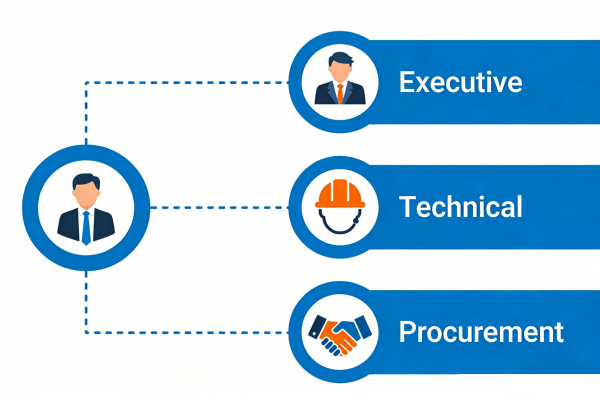
Within each target company, map out the decision chain. Identify technical decision-makers (engineers, CTOs), economic buyers (procurement leaders), and end users. Each role has different priorities—engineers focus on specifications, procurement teams on cost and delivery, and executives on strategic fit.
Content must be tailored accordingly.
▶ 3. Content Layering
Avoid publishing a single generic message across all channels. Instead, develop layered content for different audiences:
Technical audiences: application notes, troubleshooting insights
Procurement audiences: delivery case studies, compliance certifications
Executive audiences: industry trends, partnership vision
Each stakeholder should be able to find content that serves as relevant trust evidence.
▶ 4. Long-Term Engagement Rhythm
B2B decision cycles can span 6–18 months. Social media is not about immediate conversion, but about sustained visibility. Through consistent content cadence, your brand should appear at critical decision points—such as budget planning or vendor evaluation—gradually becoming part of the internal discussion.
| Dimension | Mass Traffic Approach | Account-Based Approach | Business Impact |
|---|---|---|---|
| Objective | Followers and impressions | Target account coverage and engagement | Focus on high-value leads |
| Content Strategy | Broad industry topics | Targeted pain-point content | Higher relevance and resonance |
| Reach Method | Wide ad distribution | Decision-maker-level targeting | Lower customer acquisition cost |
| Performance Metrics | Click-through rate (CTR) | Inclusion in procurement discussions | Shorter sales cycle |
This comparison highlights a fundamental shift in strategy. In manufacturing, being part of the internal discussion within 200 target accounts is far more valuable than having 20,000 irrelevant followers. When your name is mentioned during supplier evaluation, social media has delivered real business value.
3. Key Metrics: How to Measure Target Account Penetration
Once the strategy is in place, success must be measured using metrics tied directly to business outcomes—not vanity metrics.
▶ Step 1: Define Target Accounts
Sales and marketing teams should jointly identify the top 200 target companies for the year. Collect their LinkedIn company pages and key decision-maker profiles, and maintain a dynamic tracking system.
▶ Target Account Coverage
Out of the defined target list, how many companies have decision-makers who follow your account or engage with your content? This should be a core KPI.
▶ Decision Chain Engagement
Engagement should be evaluated not just by volume, but by who is engaging. Are multiple roles—technical, procurement, and executive—interacting with your content? Single-role engagement is insufficient for complex B2B decisions.
▶ Content Asset Reuse
Are your social media assets being used by the sales team in follow-ups, emails, or trade show conversations? High reuse indicates that content has become a sales enablement tool, not just marketing output.
💡 Landelion Insight: In B2B social media, the cost of precise targeting is far lower than the cost of wasted traffic.
Conclusion: From Traffic Thinking to Account Thinking
Traffic brings visibility. Target accounts generate revenue. As manufacturing companies compete globally, social media is no longer just a branding tool—it becomes an extension of the sales system.
Only when content is built around target accounts and consistently engages their decision-making process can social media deliver real business impact.
Take Action: Strengthen Your Decision-Maker Reach
Want to evaluate whether your social media content is effectively reaching decision-makers?
Landelion helps you identify gaps in your B2B marketing—across localization, trust, and conversion—so your brand is not just seen, but understood.
📩 Contact us to learn more about our global marketing services
💬 Add us on WeChat to receive a tailored solution
📚 Further Reading
Manufacturing Content Compounding Strategy: Integrating Trade Shows, Website & Social Media
Manufacturing Distributor Enablement: How to Build Value-Driven Global Sales Channels
Manufacturing Trade Show Lead Conversion: A 30-Day B2B Lead Nurturing Framework