


As Chinese medical device, IVD, digital health, and biotech companies accelerate their global expansion, LinkedIn, YouTube, Facebook, and other international social platforms have become critical channels for engaging customers, KOLs, and regulatory stakeholders. Yet in healthcare, social media activity inherently carries high regulatory and reputational risks. A single inappropriate claim can trigger an FDA Warning Letter, EU market investigation, or jeopardize product access in key markets.
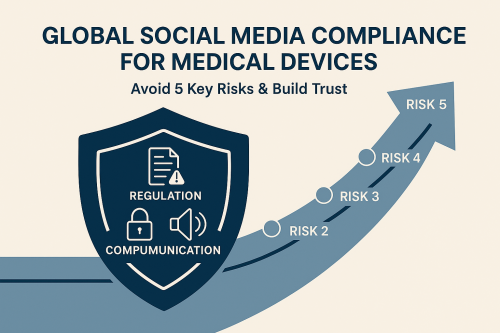
This guide outlines the five most common compliance risks in global medical device social media operations, along with actionable mitigation strategies. It also includes a downloadable Global Medical Social Media Compliance Checklist to help organizations communicate safely and credibly worldwide.
I. Why Social Media Risk Is Significantly Higher in the Medical Device Sector
Healthcare content touches patient safety, clinical decision-making, and public health—making it one of the most heavily regulated categories globally:
🔹FDA requires all product promotion to align strictly with cleared/approved indications, with efficacy claims backed by valid clinical evidence.
🔹MDR/IVDR (EU) mandates strict separation between “disease education” and “product promotion,” prohibiting implied clinical benefit.
🔹MHRA (UK), PMDA (Japan) and other regulators enforce similar oversight, including monitoring of digital communications and social channels.
Social media’s public, shareable, and permanent nature amplifies risk. A single unreviewed post can be resurfaced by competitors, regulators, or journalists months later.
👉 Bottom line: For medical device companies, social media is not just a marketing tool—it is a regulated communication channel that must operate within a defined compliance framework.
II. The Five Most Common Compliance Risks in Medical Device Global Social Media
Risk 1: Improper or Unsubstantiated Claims (Most Common FDA Violation)
Examples:
🔹Using absolute terms such as cure, eliminate, guarantee, clinically proven
🔹Showing product use in unapproved indications
🔹Presenting internal data as “clinical validation”
Regulatory consequence:
Considered off-label promotion; may trigger FDA 483 observations, Warning Letters, or EU market suspension.
SEO Keywords: FDA social media violations, medical device claims compliance, clinical evidence rules, off-label promotion
Risk 2: Patient Privacy & Data Exposure
Examples:
🔹Posting inadequately anonymized patient stories
🔹Responding to personal health questions in comments
🔹Using patient images without written consent
Compliance red lines:
Potential HIPAA (U.S.) or GDPR (EU) violations, with penalties up to 4% of global revenue.
SEO Keywords: GDPR compliance healthcare, HIPAA social media rules, patient privacy protection, digital health risk management
Risk 3: Incorrect or Misleading Technical Terminology
Examples:
🔹Translating “辅助诊断” as diagnostic in FDA context → implies Class III diagnostic device
🔹Misusing terms that differ between regulatory systems (e.g., FDA “device” vs. EU CE categories)
Even when intended as education, misuse may be interpreted as implied promotional claims.
SEO Keywords: MDR terminology accuracy, FDA terminology guidance, medical device localization errors
Risk 4: Inadequate Control of Third-Party Content (KOL, Partners, Users)
Examples:
🔹Sharing unverified KOL opinions
🔹Allowing UGC comments to include efficacy claims
🔹Influencers describing personal experience as medical endorsement
Regulatory stance:
Companies are responsible for associated third-party content, considered implicit promotion.
SEO Keywords: KOL compliance medical devices, UGC risk healthcare, third-party social media rules
Risk 5: Misinterpreting Platform Policies
Examples:
🔹Facebook restricting medical imagery
🔹YouTube categorizing technical demos as “medical advice”
🔹LinkedIn requiring promotional disclosures for competitor comparisons
Impact: Reduced reach, content removal, or account risk.
SEO Keywords: LinkedIn medical content policy, YouTube healthcare rules, Facebook medical advertising compliance
III. A Systematic Compliance-First Framework for Medical Device Social Media
To manage risk at scale, organizations must adopt a structured compliance governance model:
1. Pre-Approval & Content Governance
Mandatory review by Medical Affairs + Legal + Regional Compliance
Maintain a prohibited language list (e.g., cure, best, 100%)
Evidence ledger for all claims and data used in posts
2. Region-Specific Compliance Adaptation
Tailor content templates for FDA, MDR/IVDR, PMDA, MHRA
Use certified medical localization experts to ensure precise terminology
Consider language requirements (e.g., MDR Article 10(11) obligations)
3. Social Media Risk Management Operations
KOLs must sign compliance statements
Automated monitoring for high-risk keywords (e.g., “guarantee”)
Quarterly updates on regulatory changes impacting social media
👉 Principle: In global healthcare, compliance is the brand. Every safe communication builds trust capital; every violation erodes it.
IV. Frequently Asked Compliance Questions
Q1: What restrictions does FDA place on social media promotion of prescription devices?
Prescription devices must target licensed professionals only and include balanced risk information. Direct-to-consumer promotion is highly restricted and often inadvisable.
Q2: What are MDR/IVDR language rules for social media content?
MDR Article 10(11) requires manufacturers to provide information in the official language(s) of the Member State where the device is marketed—unless the Member State explicitly allows English for professional audiences.
Q3: What social media rules does PMDA enforce?
PMDA requires truthful, non-exaggerated information, clear disclosure of risks, and prohibits direct consumer advertising for many high-risk products.
Q4: How should companies handle user-generated content (UGC)?
FDA allows voluntary correction of third-party misinformation without pre-clearance, but companies must document corrections and clearly state scope.
Q5: What are MHRA requirements for UKCA usage on social media?
UKCA must be visible (≥5mm), applied by the manufacturer or UKRP, and technical files must be retained for 10 years.
V. Download: Global Medical Device Social Media Compliance Checklist
To support medical device, IVD, and digital health teams, the checklist includes:
✅ 5 risk-area audit lists (FDA/MDR/MHRA aligned)
✅ Social media promotion vs. education decision tree
✅ Third-party & KOL compliance screening
✅ Multi-market banned word list
👉 Click here to download:  医疗企业海外社媒内容合规检查表:五大维度、决策树与禁用词库.pdf
Need help with compliance, localization, or global social media governance?
📚 Further Reading
Medical Translation: Top Tips for Avoiding Translation Errors in FDA Certification